
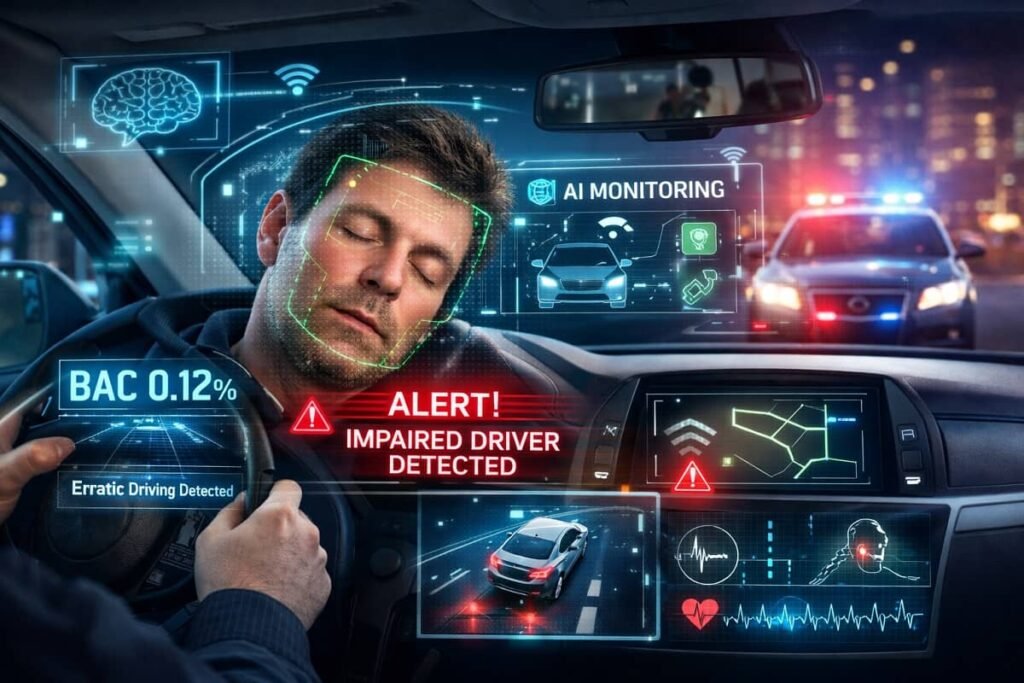
Drunk driving remains one of the most persistent and deadly road safety challenges worldwide. Despite stricter laws, awareness campaigns, and decades of enforcement, driving under the influence (DUI) continues to cause thousands of deaths and injuries every year. Traditional methods—breathalyzers, sobriety checkpoints, and police patrols—have saved lives, but they are largely reactive. They catch impaired drivers after risky behavior has already occurred.
Today, a new wave of future technology is reshaping how societies approach DUI prevention and enforcement. Artificial intelligence (AI), advanced sensors, smart vehicles, and data analytics are moving the focus from punishment to prevention and early detection. This raises an important question: Can AI and emerging technology truly stop drunk driving?
This article explores the future of DUI detection technology, how AI is being used to identify impairment, and whether these innovations can realistically eliminate drunk driving from our roads.
The Limitations of Traditional DUI Detection
Before exploring future technologies, it’s important to understand why existing DUI enforcement methods have limits.
1. Breathalyzers and Blood Tests
Breathalyzers are accurate, but they require a traffic stop. Blood tests are even more precise but are invasive and time-consuming. Both methods detect intoxication after a driver has already been operating a vehicle.
2. Sobriety Checkpoints
Checkpoints act as strong deterrents, but they are costly, manpower-intensive, and legally restricted in some regions. They also only operate at specific times and locations.
3. Field Sobriety Tests
These tests rely heavily on officer judgment and can be influenced by fatigue, medical conditions, or nervousness, sometimes leading to disputes in court.
These limitations have pushed researchers, automakers, and governments to explore automated, continuous, and predictive solutions.
The Rise of AI in DUI Detection
Artificial intelligence is at the center of next-generation DUI prevention. Unlike traditional tools, AI systems analyze patterns of behavior rather than relying on a single measurement like blood alcohol content (BAC).
How AI Detects Impairment
AI does not “test” alcohol directly. Instead, it looks for indicators of impairment such as:
-
Erratic steering patterns
-
Delayed reaction times
-
Lane drifting
-
Inconsistent braking
-
Abnormal acceleration
-
Facial and eye movement changes
By comparing real-time driving behavior with baseline patterns, AI can detect impairment caused by alcohol, drugs, fatigue, or distraction.
In-Vehicle AI Monitoring Systems
Modern vehicles are quickly becoming rolling data centers. Future DUI detection will largely happen inside the car itself.
1. Driver Monitoring Cameras
Many new vehicles already include inward-facing cameras designed to detect drowsiness or distraction. AI enhances these systems by analyzing:
-
Eye blink rate
-
Eye tracking and gaze direction
-
Head position
-
Facial muscle movement
Alcohol and drugs often cause slower blink rates, poor eye focus, and delayed facial responses. AI can flag these subtle indicators long before visible signs of intoxication appear.
2. Steering and Driving Behavior Analysis
AI systems continuously analyze steering input, lane positioning, and pedal pressure. Drunk drivers tend to overcorrect, weave, or react late to road changes.
If the system detects high-risk behavior, it can:
-
Alert the driver
-
Activate safety modes
-
Limit vehicle speed
-
Notify emergency services (in severe cases)
3. Touch and Gesture Sensors
Some experimental vehicles use sensors in steering wheels or touch panels to measure grip pressure, tremors, or delayed responses—another potential indicator of impairment.
AI-Powered Breath and Biometric Sensors
While traditional breathalyzers require active participation, future systems aim to make detection passive and seamless.
1. Touch-Based Alcohol Sensors
Researchers are developing sensors that can detect alcohol through the skin when a driver touches the steering wheel or start button. These systems analyze ethanol vapor emitted from the skin.
2. Cabin Air Analysis
Advanced sensors inside the vehicle cabin can analyze air composition to detect alcohol particles, even without direct breathing into a device.
3. Combined Biometric Profiling
By combining:
-
Skin sensors
-
Facial analysis
-
Driving behavior
AI can significantly reduce false positives and improve detection accuracy.
Ignition Interlock Devices: The Smart Evolution
Ignition interlock devices (IIDs) are already used in many countries for convicted DUI offenders. However, future versions will be far more advanced.
Traditional vs AI-Enabled Interlocks
Traditional IIDs
-
Require a breath sample
-
Can be bypassed or tampered with
-
Only test at startup
Future AI-Powered Interlocks
-
Use facial recognition to verify the driver
-
Monitor driving behavior continuously
-
Retest passively while driving
-
Detect drug impairment as well as alcohol
These smarter systems are being explored not only for offenders but potentially for commercial fleets, public transport, and high-risk drivers.
AI and Law Enforcement: Smarter DUI Policing
AI is also transforming how police detect and prevent DUI on the roads.
1. AI-Assisted Traffic Cameras
Future traffic cameras can analyze:
-
Vehicle swerving
-
Sudden braking
-
Failure to maintain lane
When AI identifies suspicious driving patterns, it can alert nearby patrol units in real time.
2. Predictive Policing Models
By analyzing historical DUI arrest data, accident reports, weather conditions, and event calendars, AI can predict:
-
High-risk locations
-
Peak DUI times
-
Likely offender patterns
This allows law enforcement to deploy resources more efficiently.
3. Automated Roadside Screening
Some regions are testing AI-enhanced roadside screening tools that analyze speech patterns, facial cues, and eye movement during brief interactions.
Can AI Detect Drug-Impaired Driving?
Alcohol is not the only concern. Drug-impaired driving—caused by cannabis, opioids, prescription medications, and synthetic drugs—is increasing worldwide.
The Challenge
Unlike alcohol, drugs do not have universally accepted impairment thresholds. Blood tests are complex, and effects vary widely.
AI’s Advantage
AI focuses on functional impairment, not substance levels. It identifies:
-
Slowed reactions
-
Cognitive delays
-
Motor coordination issues
This makes AI uniquely suited to detect impairment from substances that are otherwise difficult to measure.
Connected Cars and Vehicle-to-Everything (V2X) Technology
Future DUI prevention won’t rely on isolated vehicles. Connected ecosystems will play a major role.
How V2X Helps
Vehicles will communicate with:
-
Other vehicles
-
Traffic signals
-
Road infrastructure
-
Law enforcement systems
If an AI system detects an impaired driver, it could:
-
Warn nearby vehicles
-
Adjust traffic signals to reduce collision risk
-
Automatically guide the vehicle to a safe stop
Ethical and Privacy Concerns
Despite its promise, AI-based DUI detection raises serious ethical questions.
1. Privacy
Constant monitoring of facial expressions, biometrics, and driving behavior can feel invasive. Questions arise about:
-
Who owns the data?
-
How long is it stored?
-
Can it be used in court?
2. False Positives
Medical conditions, fatigue, anxiety, or neurological disorders could be mistaken for intoxication. Ensuring accuracy is critical to prevent wrongful penalties.
3. Consent and Regulation
Should AI DUI detection be mandatory? Or optional? Governments will need clear regulations balancing safety and civil liberties.
Will AI Replace Police in DUI Enforcement?
The short answer: No—but it will augment them.
AI excels at:
-
Continuous monitoring
-
Pattern recognition
Human officers remain essential for:
-
Judgment calls
-
Legal procedures
-
Handling complex real-world scenarios
The future of DUI enforcement is likely a hybrid model, where AI prevents risk and police intervene when necessary.
Can AI Really Stop Drunk Driving?
AI alone will not eliminate drunk driving overnight. However, it can dramatically reduce incidents by:
-
Preventing intoxicated drivers from starting vehicles
-
Detecting impairment early
-
Reducing reliance on random enforcement
-
Encouraging safer behavior through accountability
Just as seat belts and airbags reshaped road safety, AI-powered DUI prevention could become a standard feature in future vehicles.
The Road Ahead
Automakers, governments, and technology companies are increasingly aligned on one goal: zero traffic fatalities. AI-based DUI detection is a critical part of that vision.
In the coming years, we can expect:
-
Mandatory driver monitoring systems
-
Smarter ignition interlocks
-
AI-assisted law enforcement
-
Stronger legal frameworks around impairment detection
While challenges remain, the question is no longer if technology can help stop drunk driving—but how quickly it will be adopted.
Conclusion
The future of DUI enforcement is shifting from reactive punishment to proactive prevention. AI, biometric sensors, and connected vehicle systems offer a powerful new approach to detecting impaired driving before it turns deadly.
So, can AI stop drunk driving?
Not entirely on its own—but combined with smart policy, ethical safeguards, and public acceptance, it may finally bring us closer to roads where impaired driving is no longer the norm, but a preventable exception.