
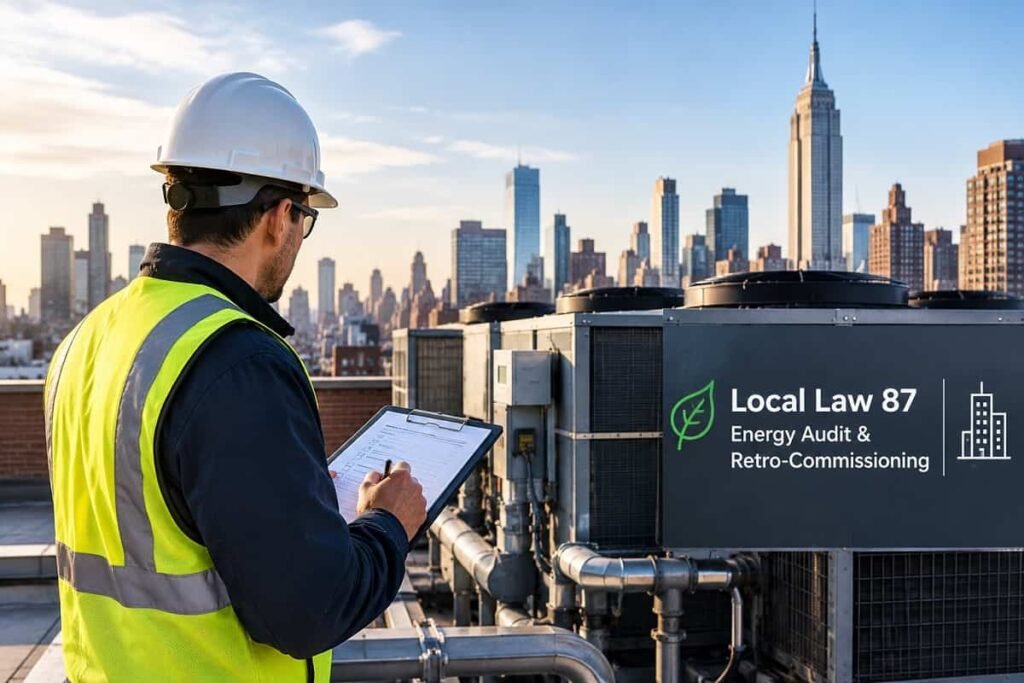
Local Law 87 (LL87) is a New York City set of regulations that require significant buildings to be inspected, modified, and submitted an energy report to the NYC Department of Buildings. This local law was enacted to help New York fulfill its environmental targets by analyzing the energy and environmental performance of the most demanding structures and improving (if needed) the utilization of the building’s machinery, processes, or electrical wiring.
Local Law 87 compliance steps
Large buildings (over 50,000 square feet) that do not qualify for an exemption must perform the following procedures every 10 years to comply with LL87. The Energy Efficiency Report is due by December 31 of the year assigned to the building, which is determined by the last digit of its tax block number.
1. Energy Audit
The audit of the building must be performed or supervised by a qualified professional (a New York-licensed Professional Engineer or Registered Architect, or a DOB-registered energy auditor), who cannot be on the staff of the building being audited, and all the conclusions drawn from the audit must be submitted to the Department of Buildings in the form of an energy efficiency report. The report contains audit and retro-commissioning data. The energy efficiency of all basic building systems, including the
- Building envelope
- Ventilation System
- Electrical and lighting systems
The audit must identify all possible activities and capital improvements that might result in lower energy use or expenses and the associated savings, implementation costs, and short payback period.
2. Retro-Commissioning
After finishing an energy efficiency study, owners must ensure that the critical basic systems have been retro-commissioned by a retro-commissioning agency. Following things must be included in the report:
- The building’s basic systems
- Inventory of existing equipment
- Calibration and sequencing
- Cleaning and maintenance
- Training and documentation challenges
The retro-commissioning report must include information about the project team, the building, the testing method, a master list of outcomes, and a list of defects that have been corrected. No- or low-cost measures identified during retro-commissioning must be implemented.
3. Energy Efficiency Report
To achieve LL87 compliance, we finish and submit the Energy Audit and Retro-Commissioning reports to the NYC Department of Buildings. A filing fee also applies. Owners who can’t meet the deadline may be eligible to apply for a deferral or an extension.
Penalties for Noncompliance with LL87
Financial penalties apply if the EER is not submitted by the due date. If you fail to submit the EER by the deadline, the DOB will charge you $3000 for the first year and $5000 for each consecutive year until the EER is submitted. The penalties are cumulative, and DOB will not accept a late EER until all outstanding penalties are paid.
Why should you hire professionals for conducting Energy audits and Retro-Commissioning?
Energy audits and retro-commissioning are complex operations that need the technical expertise of qualified MEP professionals. They are possibly the most time-consuming part of Local Law 87 compliance since, if not properly evaluated, you may be compelled to make costly revisions to your Energy Efficiency Report.
If the Department of Buildings finds problems in your EER, it may request modifications, which can add cost and delay. It is advisable to prevent complications by hiring a qualified engineer to do energy audits and retro-commissioning before being penalized for modifications due to incorrect results.
Conclusion
Local Law 87 requires large NYC buildings to complete an energy audit and retro-commissioning every 10 years and to file the results with the Department of Buildings by December 31 of the assigned year. Missing the deadline brings cumulative penalties, and the DOB will not accept a late report until they are paid. Start early, confirm your building’s due date and any exemption, deferral, or extension options, and work with qualified professionals so the report is accepted the first time. Done well, LL87 also gives you a clear view of where your building can save energy and money, and it prepares you for related requirements such as Local Law 97.